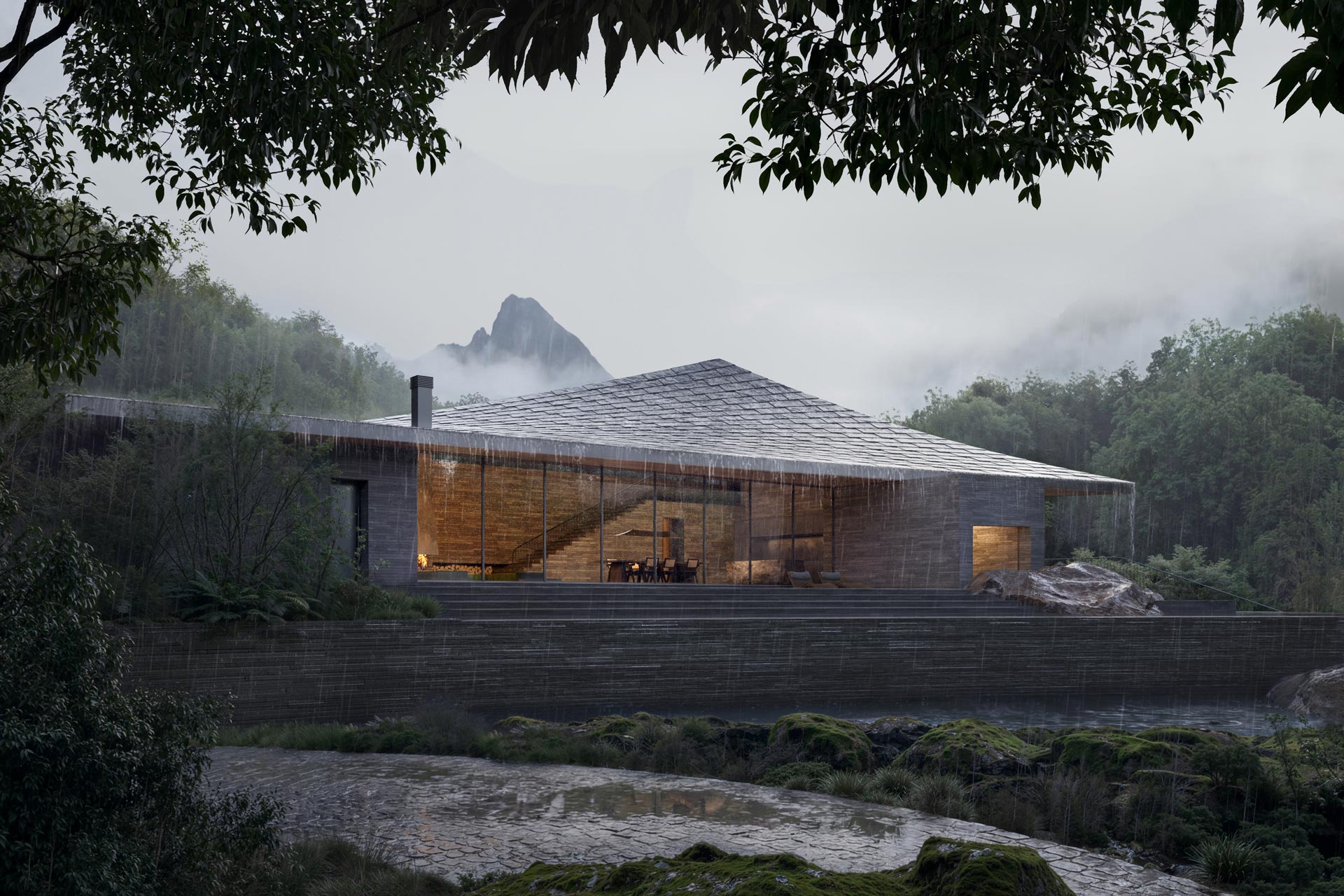
Satio Not A Hotel
A Climate-Driven House That Performs Its Own Waterfall
Hospitality architecture is competing on intelligence

According to coverage across ArchDaily and Dezeen, one shift has become undeniable in recent years: hospitality architecture is no longer competing on form, it’s competing on intelligence. Architects are designing buildings that perform like instruments, precisely tuned to climate, terrain, and atmosphere.
This shift is particularly visible in projects emerging from NOT A HOTEL, a developer experimenting with a hybrid between luxury hospitality and shared ownership. Their design competitions bring serious architectural ambition into real estate development, often through young practices hungry enough to take risks.
Our earlier collaboration with Snøhetta for the NOT A HOTEL Rusutsu project in Hokkaido was shaped by snow, open alpine views, and crisp winter light. a minimalist, geometric volume standing clean against the mountaintop. The new proposal by Satio for the Yakushima Island project operates in the opposite condition entirely. Instead of snow and horizon, the architecture confronts rain, humidity, dense forest, and moving water. Where Rusutsu was about exposure, the Yakushima design buries an earthy form into an ancient forest.
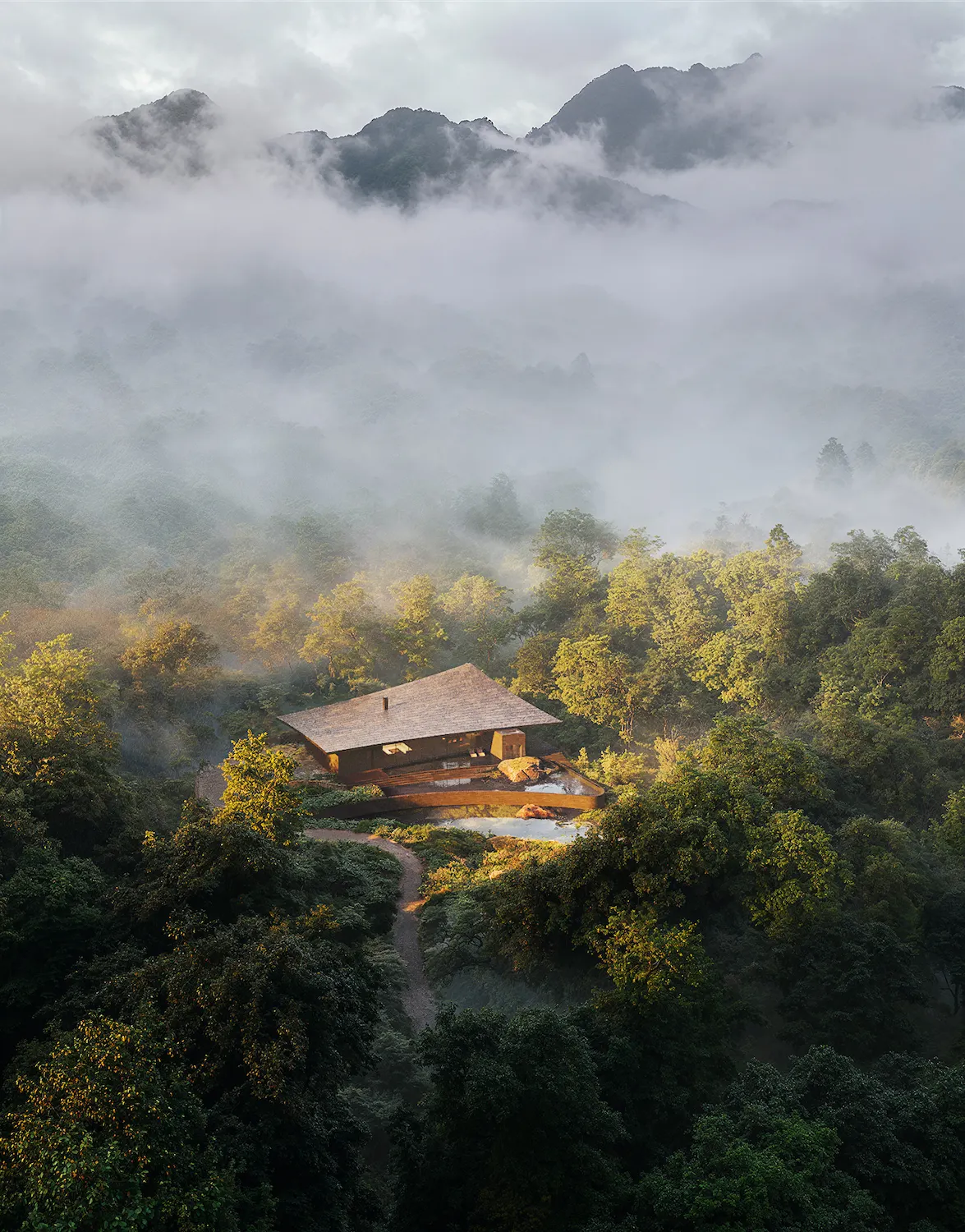
The waterfall roof
Located on the southern edge of Japan, Yakushima receives some of the heaviest rainfall in the country, roughly 300 days a year of precipitation. The island’s ancient cedar forests, some over a thousand years old, exist within a landscape shaped by erosion, waterfalls, and persistent mist. The terrain itself is a single massive rock formation, continuously reshaped by water cycles at every scale.
Designing in such conditions demands a fundamentally different approach. Weather is not a background condition to manage, it becomes the primary design driver.
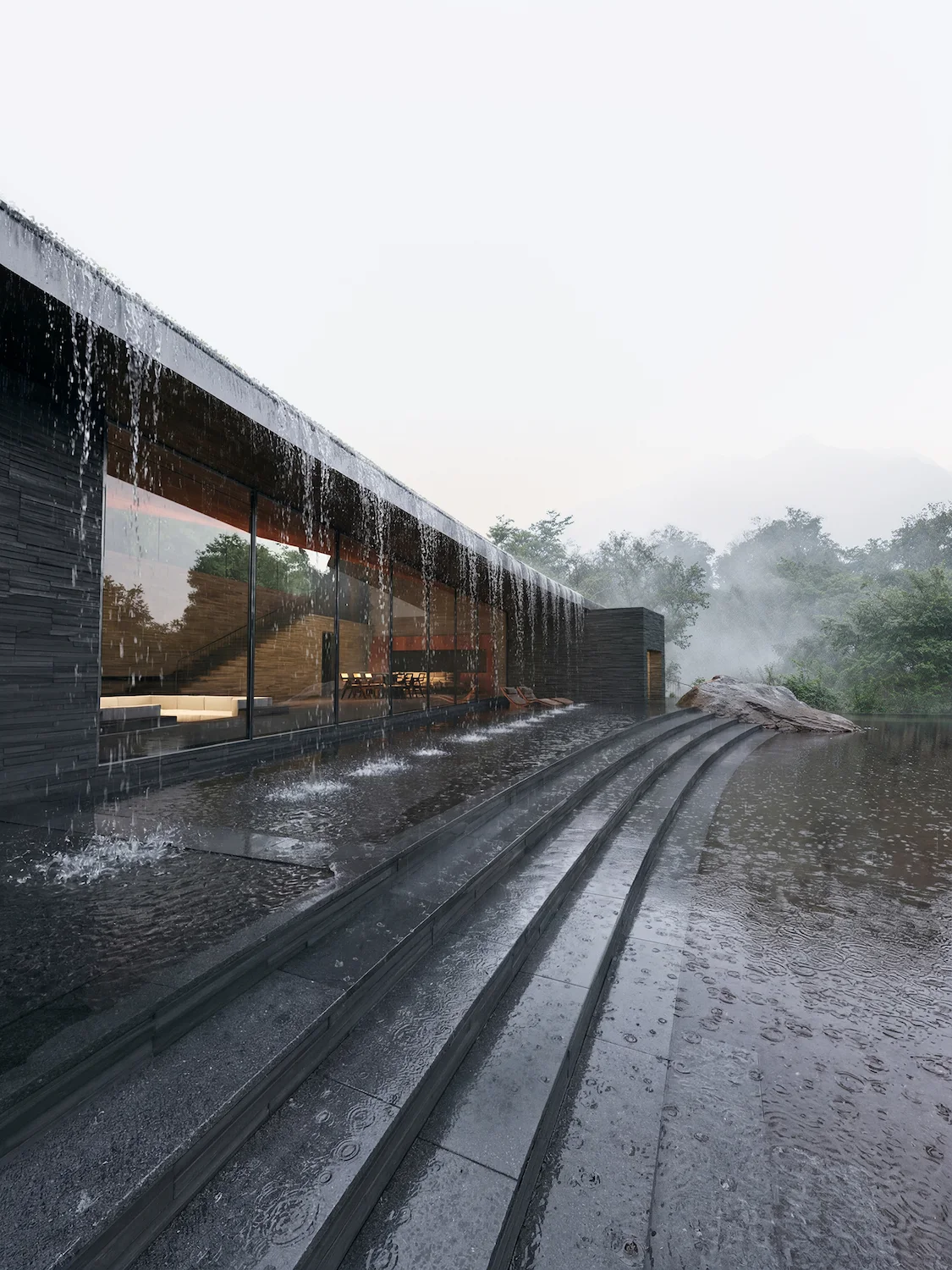
One move, four logics
In most architectural renderings, rain is treated as a problem, something marketing teams erase in favor of clear skies where materials and details read cleanly. The architects at Satio insisted on another way to introduce the project.
Yakushima is not a place of perpetual sunshine. It is a place defined by water. Designing imagery around rain is therefore not an aesthetic preference; it’s architectural integrity.
The roof becomes the project’s most powerful element because it ties to the site in four distinct ways simultaneously. It echoes the mountain profile. It collects rainfall. It creates the waterfall-curtain effect that defines the building’s experiential identity. And it references the island’s own cascading water systems, natural waterfalls that drop from cliff to cliff in exactly the same logic of surface to pool to pool.
When a single architectural element connects to its concept and its context through three or four independent logics, the design stops being an argument and starts becoming inevitable.
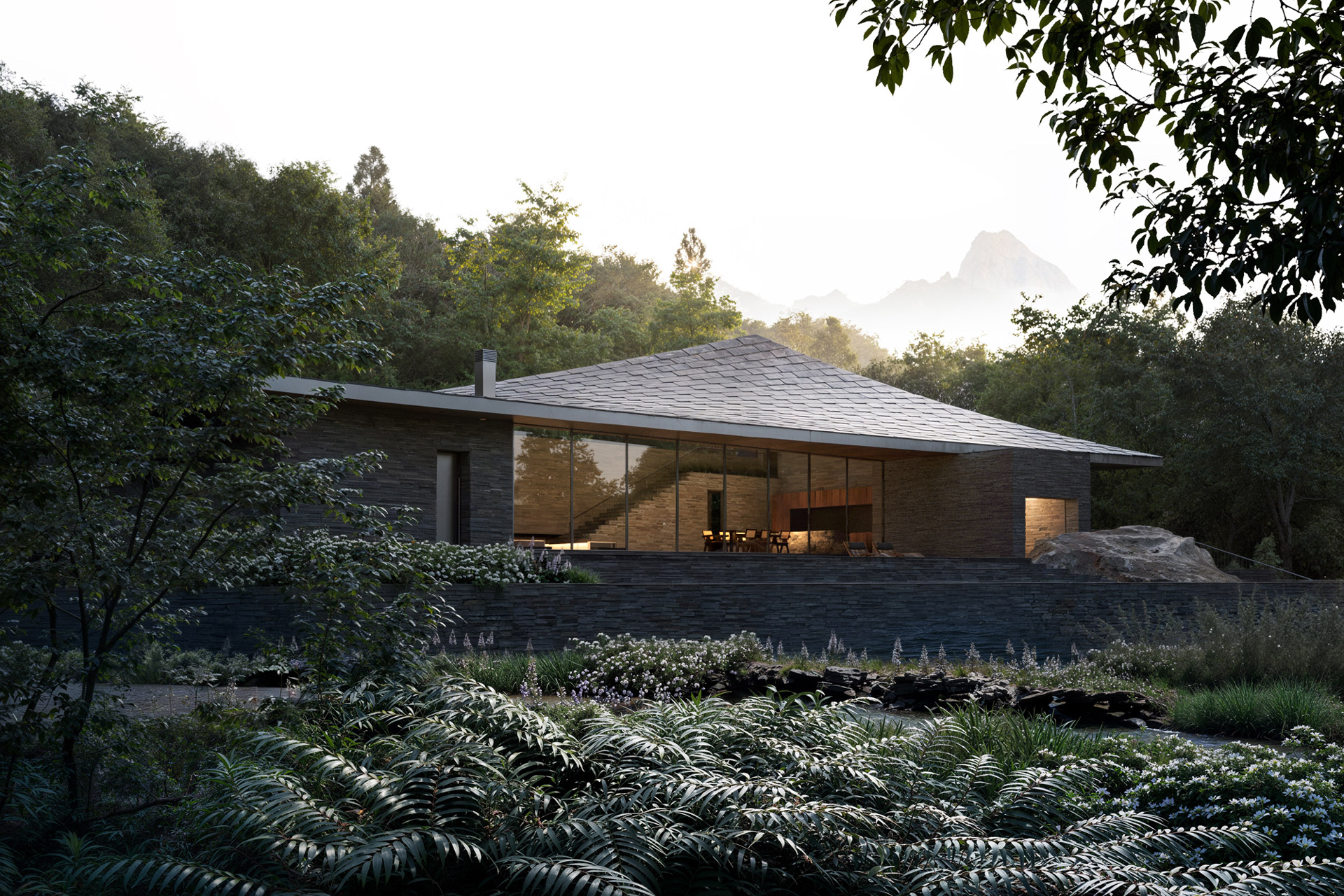
Visualization as design instrument
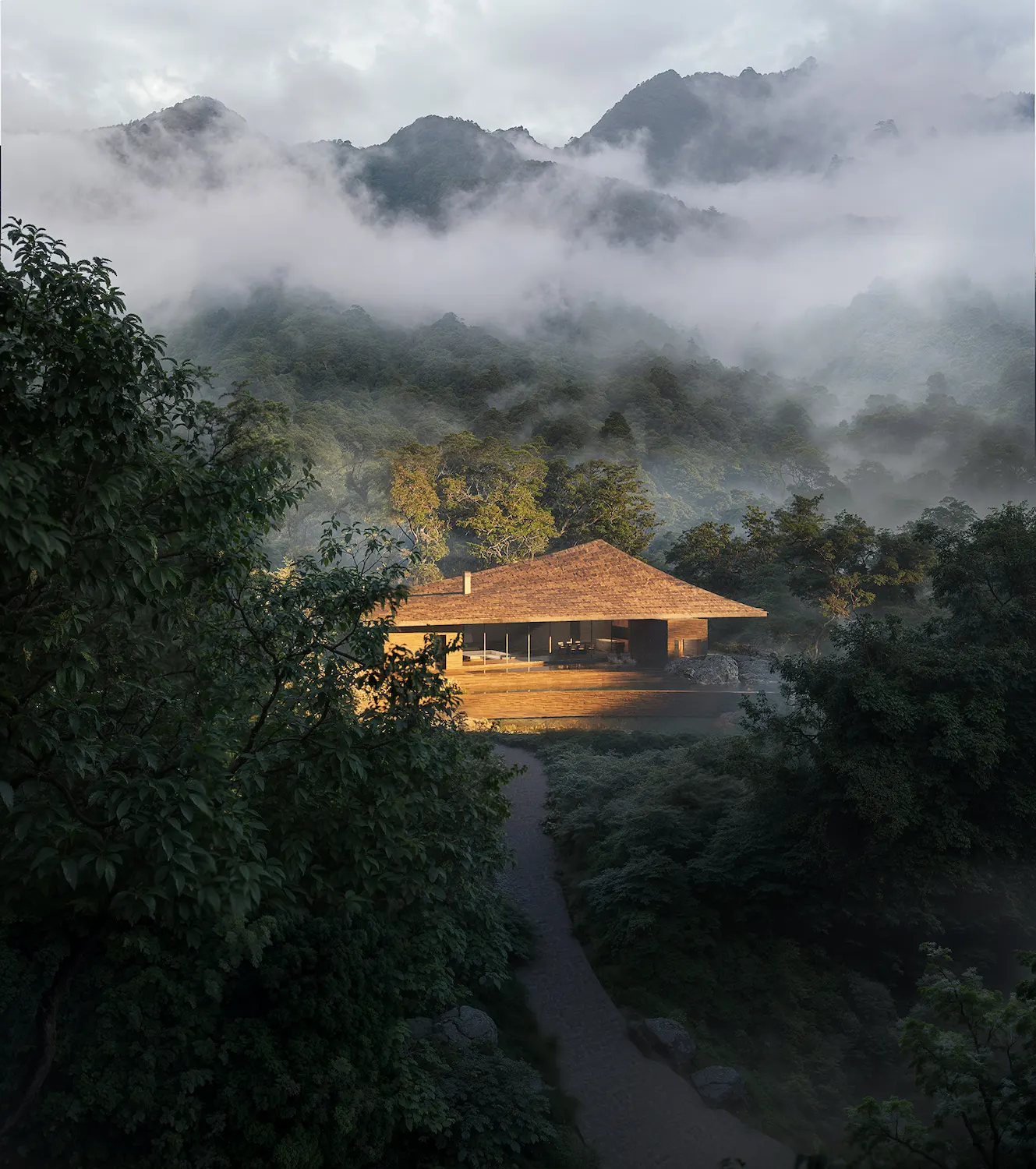
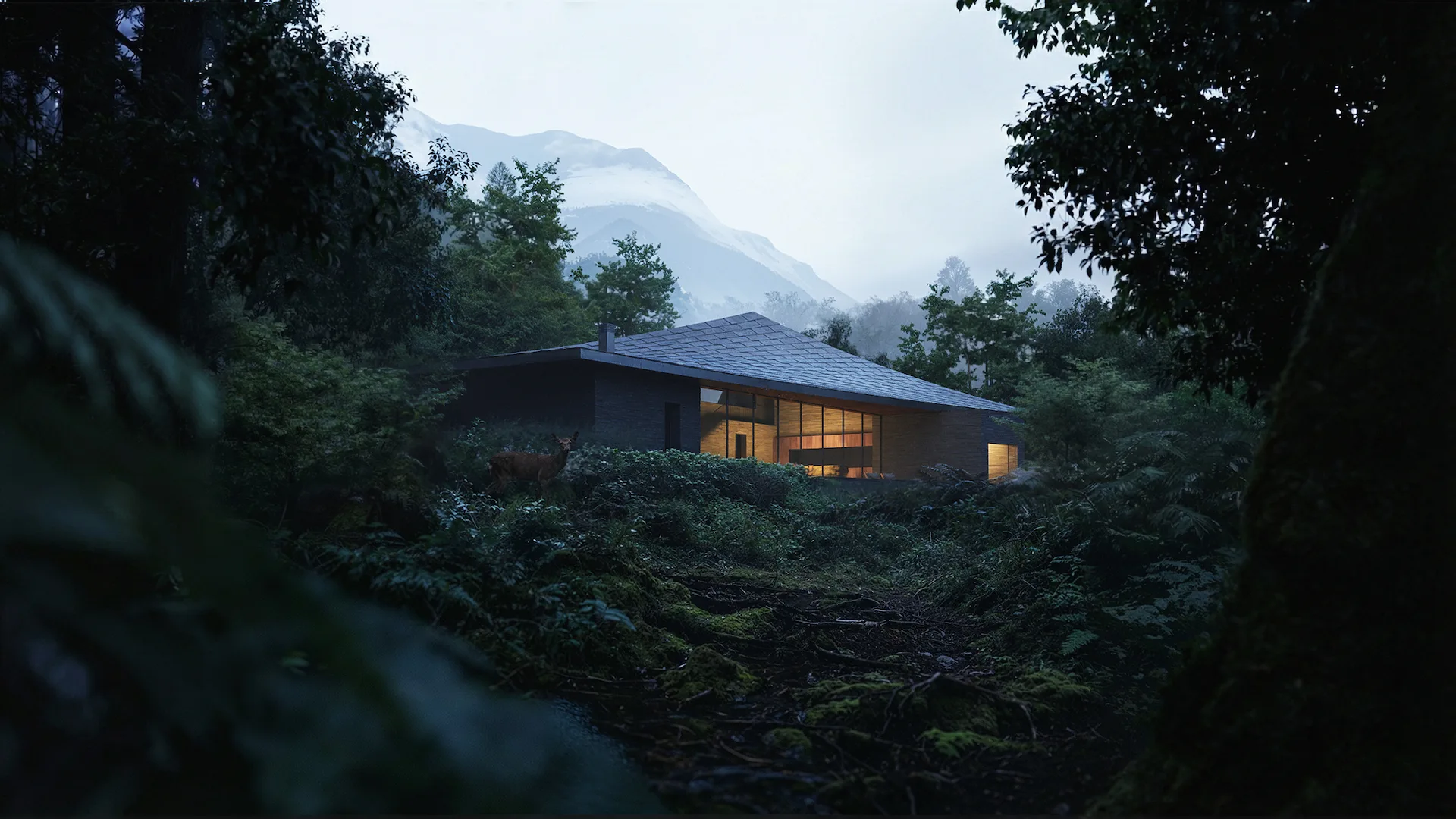
Projects like this demand a fundamentally different approach from a visualization studio. When there are no neighboring buildings or urban context, the burden of authenticity shifts entirely to the environment. Vegetation, terrain, and atmosphere carry the credibility of the image, especially on Yakushima, with its highly specific endemic species and wildlife.
For Satio’s proposal, we explored fourteen sketch compositions to arrive at the final images. Each sketch isolated a different narrative within the design. One of the biggest technical challenges was transforming documentary site photography into the atmosphere envisioned by the architects. Lighting conditions, fog density, mountain visibility, and the quality of moisture in the air all had to be carefully rebalanced.
A broader shift
Satio’s proposal was developed for the NOT A HOTEL Design Competition 2026, a program targeting architects under forty with the promise that winning entries could move toward real construction and sale.
That premise fundamentally changes how architects engage the brief. Unlike purely academic competitions, these proposals must operate within real development logic, cost, feasibility, and market clarity. The architecture has to work.
Architectural competitions, and the visualization process behind them, are less about producing the most dramatic image and more about articulating a coherent relationship between architecture and experience. In that sense, projects like this one signal a broader shift. The most memorable architecture is no longer competing on form alone. It is competing on the depth of its connection to location.
And that connection starts with understanding what the place actually is. Not the postcard version. The rainy one.
For our team at ZOA Studio, the value of projects like this lies in that clarity. Every project demands its own logic.
The images serve the idea. Not the other way around. Because when the architecture truly belongs to its environment, the visuals don’t need to perform. They just need to be honest.
Project details
Location
Yakushima, Japan
Design
Developer
Team
Bence Falussy
Luka Popovic
Mohamed Atef
