Rákosrendező Masterplan
Visualizing Budapest's Largest Urban Competition
The winning proposal

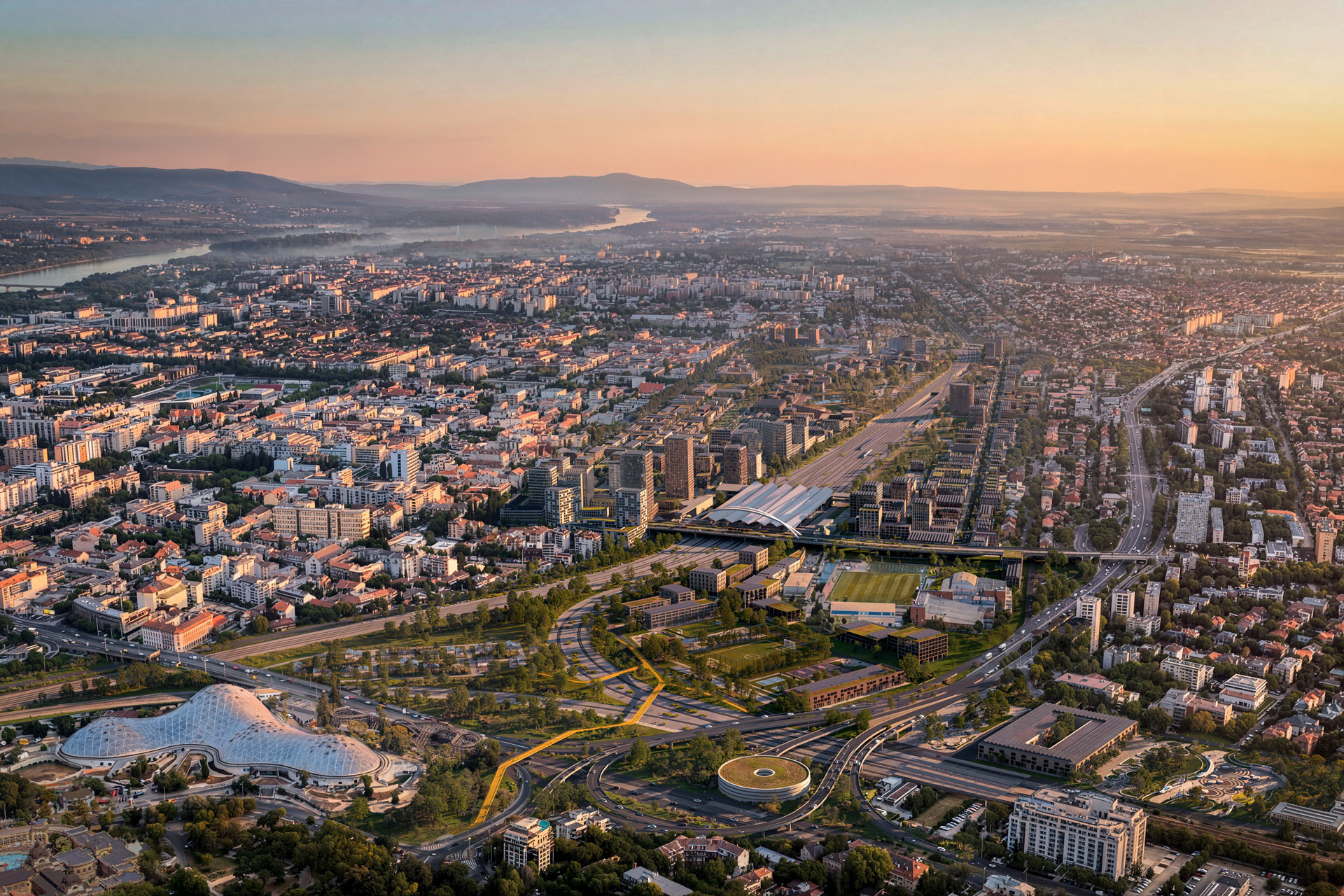
On March 30 2026, Budapest announced the winner of the largest urban design competition the city has seen in generations. The site in question, Rákosrendező, spans a 244-hectare planning area between the XIII and XIV districts—86 hectares of it disused railway land acquired by the municipality—vast enough to feel, even now, more like an absence than a neighbourhood. Over the next two decades, that absence is meant to become a new piece of city: a place where nearly 30,000 people will live, move through, and spend their days.
The international competition was launched by the Budapest Metropolitan Municipality in September last year, with the aim of transforming the current railway brownfield site into a liveable, environmentally conscious and socially inclusive new district. The winning proposal came from a consortium led by the French architecture studio Coldefy, working with Cityförster, Sporaarchitects, Treibhaus Landschaftsarchitektur, Marko and Placemakers. ZOA Studio produced the renderings and aerial images that introduced the scheme to the jury, the municipality and, eventually, the press.
The competition itself was run by BFVK, Budapest’s municipal asset management body, in a two-phase process. Forty-three teams applied; sixteen were shortlisted; fourteen submitted final proposals. A 17-member jury, chaired by mayor Gergely Karácsony and co-chaired by Dávid Vitézy, deliberated for two days before selecting the Coldefy team’s entry. The jury brought together a wide range of expertise, including the chief urban development leaders of Vienna and Prague, representatives of the XIII and XIV districts, the capital and national chief architects, as well as architects, landscape architects, sustainability experts, transport specialists and real estate professionals.
The brief was ambitious: up to 10,000 apartments, at least 25 hectares of green space and an intermodal transport hub for 60,000 daily passengers, all organised around a rebuilt Rákosrendező station, an extended M1 metro and a new tram overpass. As mayor Gergely Karácsony stated at the press conference, the competition was fundamentally shaped by two key challenges: responding to the climate crisis and the housing crisis. “We were not looking for a perfect proposal, but for a good team. If we can reach an agreement with this team, the masterplan could be completed by early 2028,” he said.
By any measure, it is the kind of project that will shape a chapter of Budapest’s future. These renderings were how the jury, the municipality, and eventually the public first saw what it could become.
From block to block
Those visuals were not just meant to show a plan, but to make a place legible. At the competition stage, the masterplan still existed largely as massing: blocks with the right height, footprint, and urban logic, but none of the lived-in cues by which people instinctively understand a city. No weathered facades, no shopfronts, no eye-level texture, no signs of how a street might feel at eight in the morning or on a winter afternoon. That is normal. A masterplan competition is not about final architecture. But the tension is obvious: juries do not only assess diagrams. They respond to atmosphere, coherence and the suggestion of life.
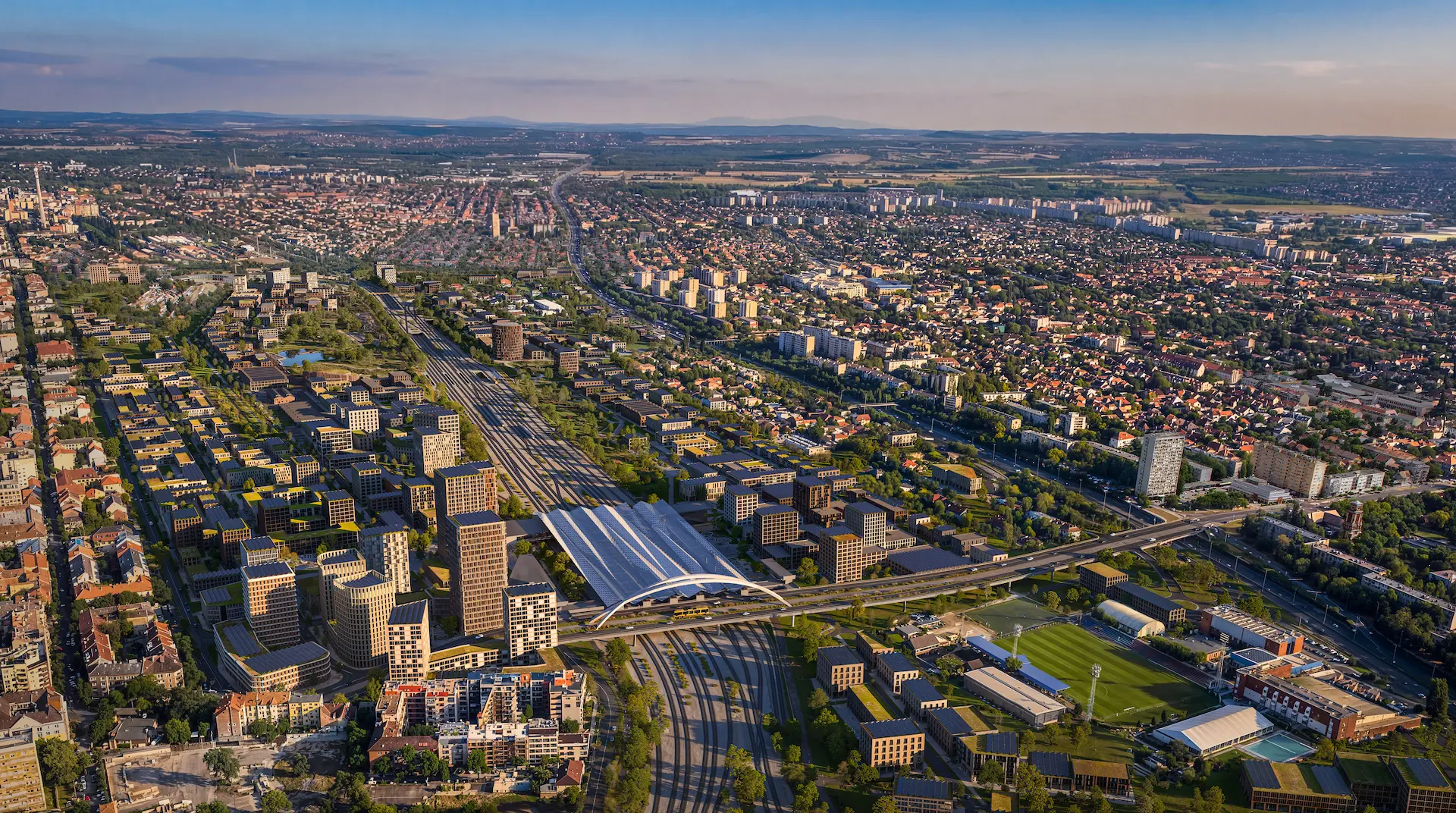
ZOA Studio approached the task with a procedural facade system developed for an earlier project. The team built a library of around 20 facade typologies that could be applied across the massing model and adjusted from block to block. The aim was not to overdesign buildings that had not yet been designed, but to give the district enough variation to feel plausible. The architects selected and assigned the typologies, so the visual character remained anchored in their intentions rather than drifting into generic imagery.
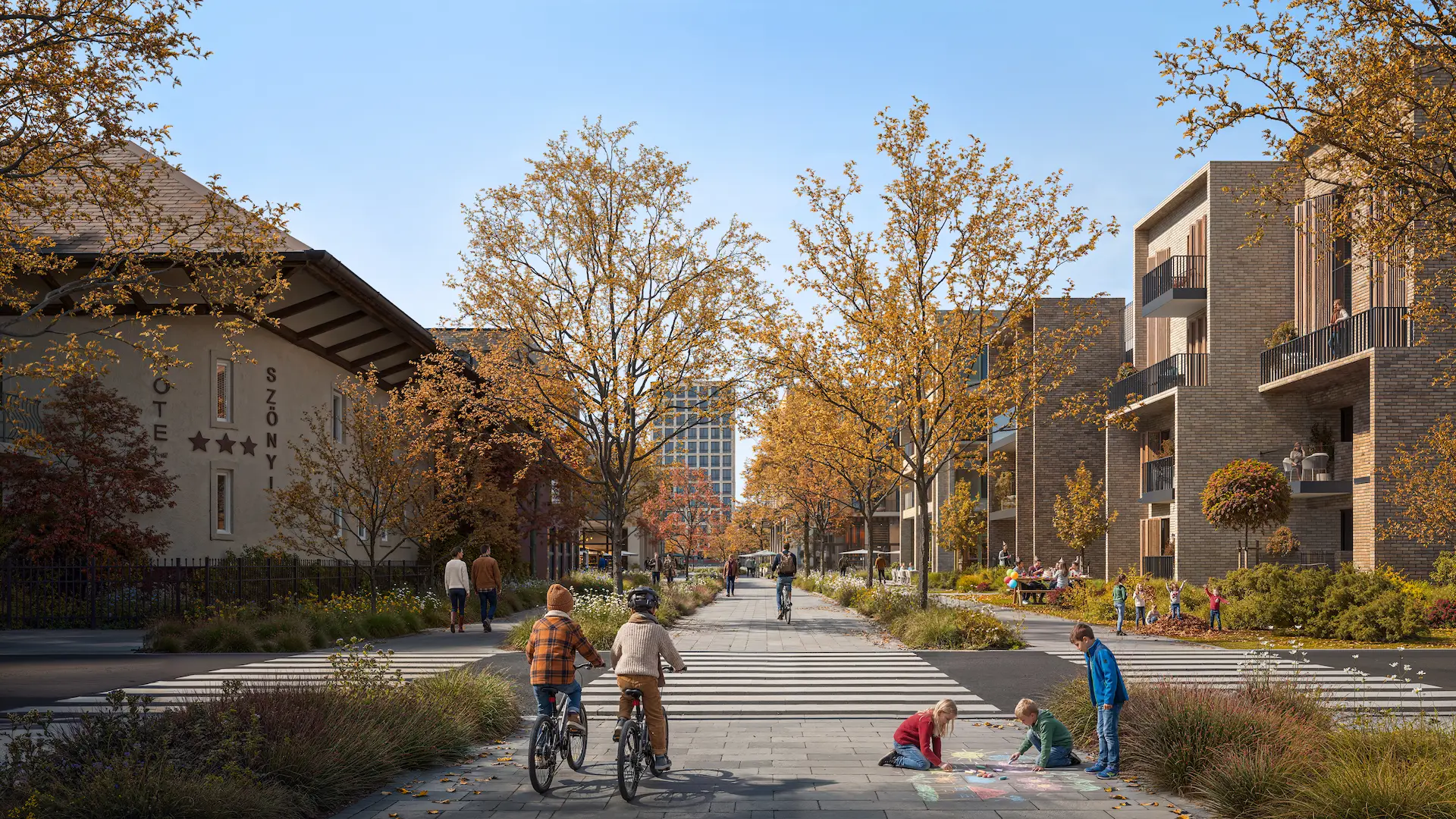
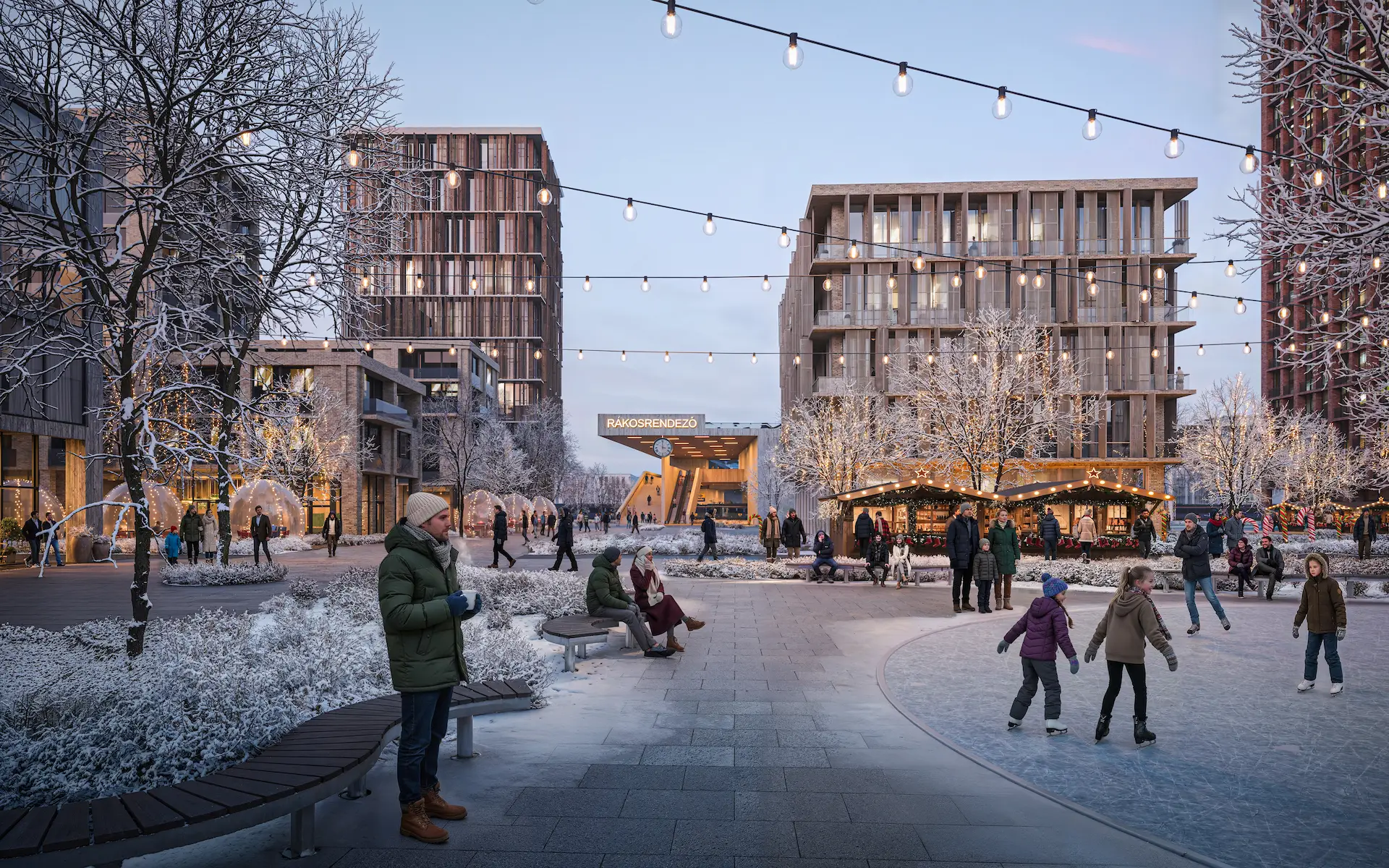
The aerials were based on drone photographs of the existing site, then relit and adapted to match the seasonal atmospheres the team wanted to convey. The street-level views were handled differently. There, the procedural base was refined more heavily, because what reads convincingly from far above can quickly turn repetitive at pedestrian scale. At eye level, the renderings needed to hold attention in a different way: through planting, paving, street furniture, shopfront rhythm, and the ordinary cues that suggest how people might actually occupy the space.
Turn volume models into a city people can feel
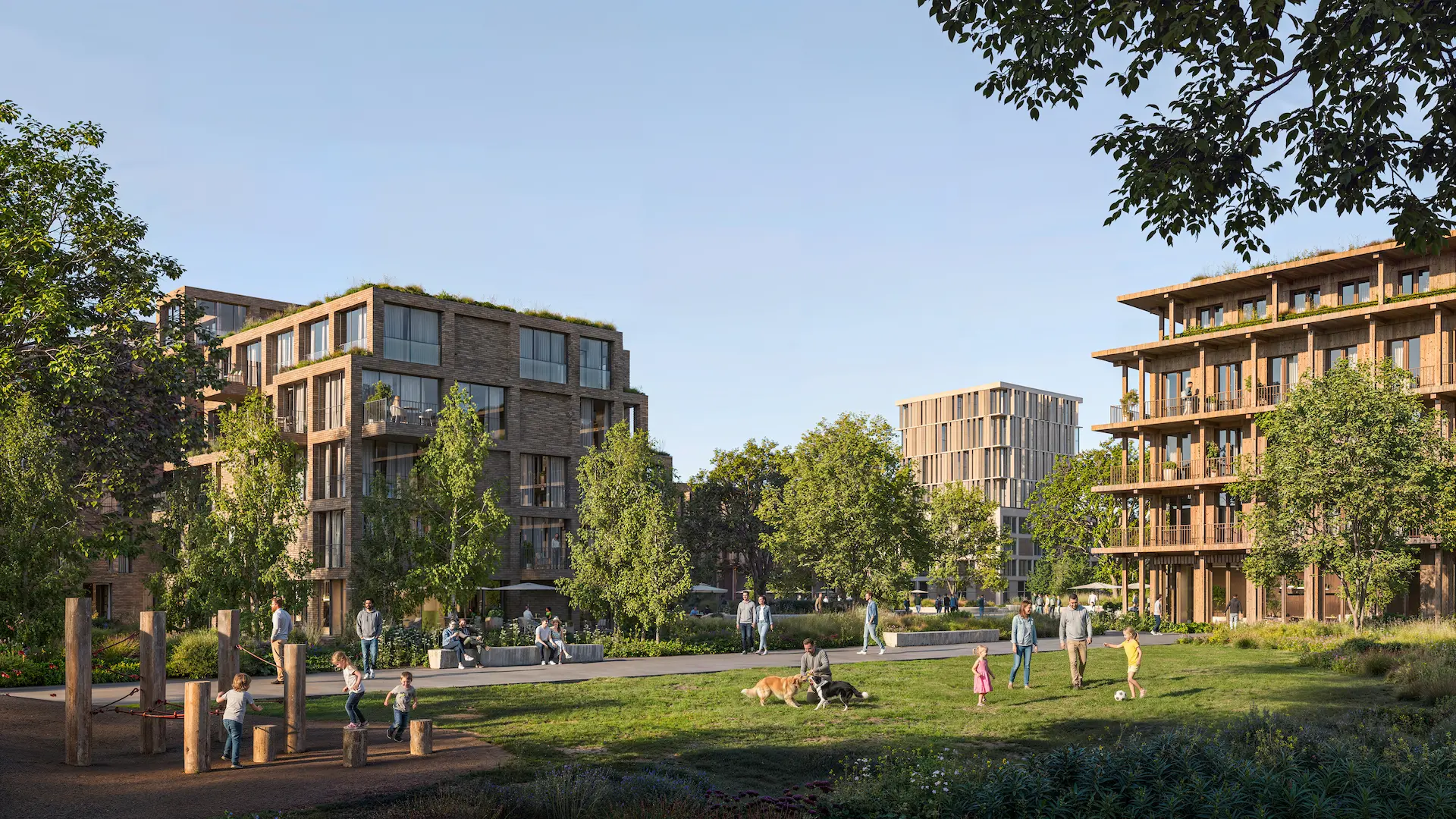
The final set of renderings stretched across the full breadth of the proposal, from the denser mixed-use core around the station to the green spine linking Rákos Creek with the new parkland and on towards the Railway History Park. The aerial views established the urban structure: six quarters connected by a ring promenade, density concentrated where public transport is strongest and a 15-hectare central park running along the railway corridor. The eye-level images made a different argument. They showed active ground floors, tree-lined shared streets and housing facing directly onto the landscape.
One image, in particular, gave most of its frame to the green spine and the housing blocks beside it. It was among the clearest expressions of the masterplan’s central promise. The park was not being treated as leftover space, or as a decorative edge condition, but as one of the organising elements of the district itself.
That distinction matters, because at masterplan stage renderings are doing two jobs at once. They need to be spatially precise enough to earn trust, while also being persuasive enough to suggest that a future district could be enjoyable, not merely functional. Too vague, and the imagery slips into mood-board territory. Too resolved, and it risks promising an architecture that does not yet exist. Most competition visuals falter at one of those two extremes.
What the renders actually carried
In a masterplan for an entire district, much of what a jury, or later, the public, understands is filtered through a relatively small set of views. The renderings are not there simply to decorate the proposal; they are one of the main ways it becomes imaginable. That is where architectural visualization shifts from presentation to interpretation.
Rákosrendező will take years to emerge. The build-out is planned to unfold over the coming decades, with the masterplan itself not expected to be finalised until around 2028. The buildings themselves will come from many architects; the planting will mature slowly; the streets will change as they are used. But long before any of that happens, the project has already had to exist in another form: as a future vivid enough for a jury to believe in.
That, in the end, is the work, not simply producing a polished final frame, but making a large and abstract proposition feel specific enough to trust. In projects of this scale, the image is not the end of the design process; it is often the moment the argument becomes clear.
Project details
Location
Budapest, Hungary
Design
Partners
Project lead
Botond Sass
