Magyar Építészeti Múzeum
Animating Hungary's New Architecture Museum
An exhibition held at the Vigadó Concert Hall

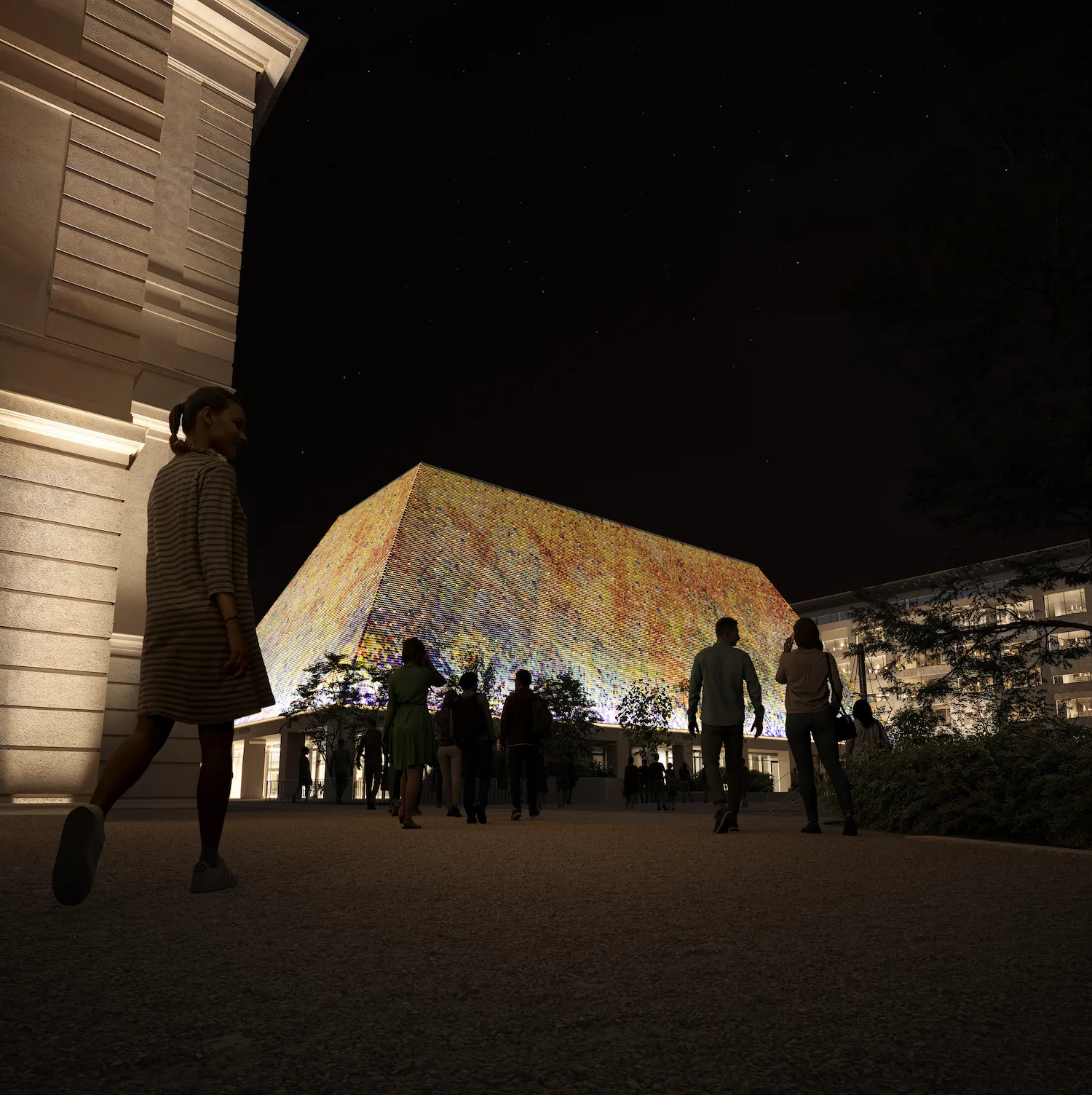
In December 2023, the Hungarian Academy of Arts announced the winner of its two-stage, invited architectural competition for a new national home for architecture. The brief was to design the Magyar Építészeti Múzeum, a 27,000 m² cultural and professional campus on a former hospital block between Városligeti Fasor and Bajza Street in Budapest, steps from the Városliget museum quarter.
Out of 40 submitted entries, the jury awarded first prize to BIVAK studio, selecting a scheme that placed a single, archetypal barn-shaped volume among restored turn-of-the-century sanatorium villas, with roughly 75% of above-ground volume realised through adaptive reuse.
The building permit followed in early 2025. ZOA Studio was commissioned to produce the full visualization package for the project’s public exhibition, a show held at the Vigadó concert hall in Budapest, designed to bring the competition work in front of the general public.
A roof that earns its own headline
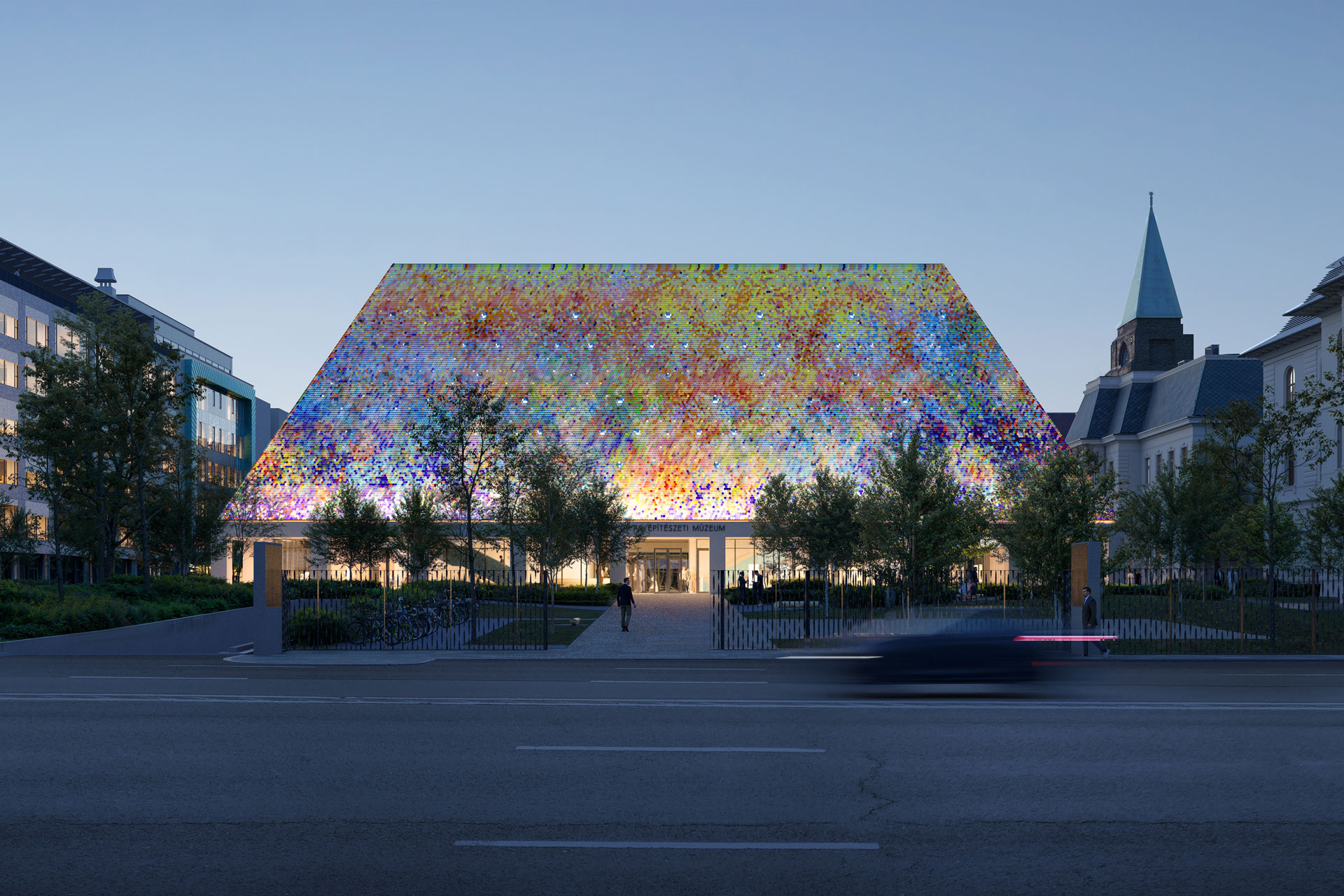
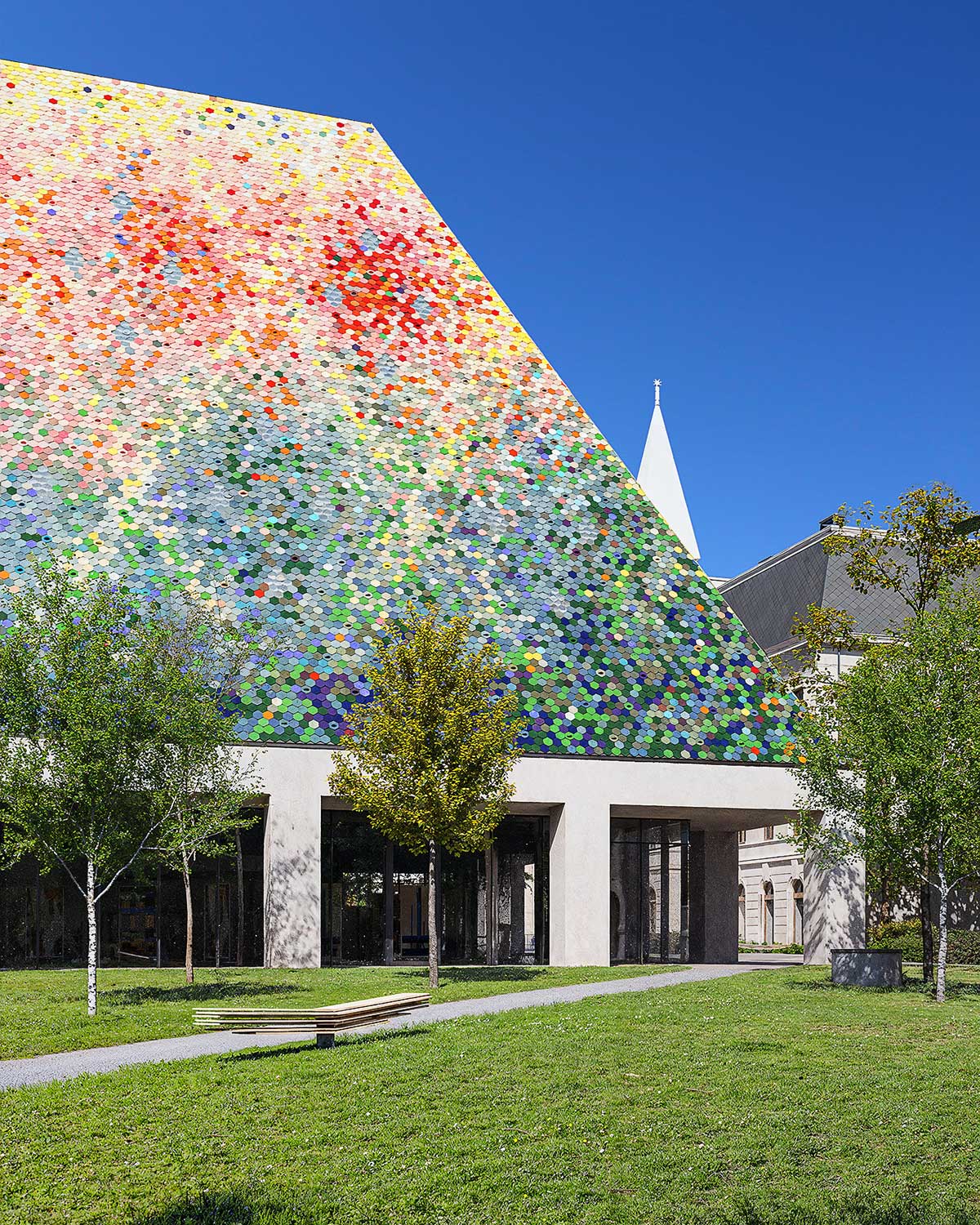
The most challenging aspect of this project was a 2,600 m² ceramic roof clad with more than 100,000 individually coloured tiles across 65 distinct shades. Each piece was specified using a vector distribution generated from a watercolour sketch that seeded a custom algorithm.
The tile pattern, built on an X-shaped motif, is mirrored in the exposed CLT and concrete beam grid of the interior ceiling, allowing the same geometry to run from the exterior skin to the structural logic within. BIVAK drew reference from the glazed, eosin-fired ceramic roofs of Budapest’s fin-de-siècle civic buildings, most notably the Iparművészeti Múzeum, reinterpreting them in a contemporary register.
It is one of the most technically demanding roof specifications in recent Central European public architecture, and it became the central visual challenge in our renderings.
Our team had to construct it from the vector colour map, assigning each of the 114,712 tiles its individual colour before a single frame could be rendered. That constraint shaped the entire production strategy. Still images were developed in parallel with the main animation, and a custom workflow made it possible to efficiently process the tile matrix.
Construction becomes the content itself
Most architectural visualization studios deliver still images for competitions. In this case, however, the exhibition brief called for no printed material, only projected content, presented as loops on screens throughout the Vigadó gallery space. The result was a suite of cinemagraphs for the portrait displays, alongside a fully hand-crafted hero animation showcasing the roof construction. This piece was produced frame by frame, reflecting the client’s understanding that the core narrative deserved a more detailed and deliberate presentation.
Looping context shots are not a substitute for sequenced, art-directed animation, where the logic of construction becomes the content itself. The roof animation unfolds in three phases: schematic diagram, structural grid, and finished ceramic surface, each held long enough to be clearly understood. It was the sequence the client hadn’t initially anticipated requesting, and ultimately the one they immediately asked to extend.
Competition architecture has traditionally been communicated through boards, sections, and renders. What the Magyar Építészeti Múzeum exhibition proposed was different: a competition entry, still under development, brought to a general public audience through moving image before the building breaks ground. No precedent was handed to us. The project sat at an unusual intersection—not a marketing campaign for a completed building, nor a pitch deck for a jury, but an immersive introduction to what a building will feel like for people who had never seen the competition documents.
That shift matters to the wider profession. As architectural animation becomes part of the design and public engagement process, rather than a final-stage deliverable, the standards for motion content must follow. Static renders communicate form; animation communicates sequence, scale, and material logic in a way no elevation can. For a museum whose mission is to make architecture legible to a non-specialist public, that distinction is fundamental to the programme.
Our role here was not to document a winning competition entry. It was to make the building’s most complex idea—a roof that carries a century of Hungarian craft into contemporary construction—something a first-time visitor to an architecture exhibition could stand in front of and immediately understand.
Project details
Location
Budapest, Hungary
Partner
Design
Bivak
Máté Tamás
Vass Eysen Áron
Consultant
Construction
Team
Róbert Andrékó
Marcelo Resala
Marcos Martinez
Links
