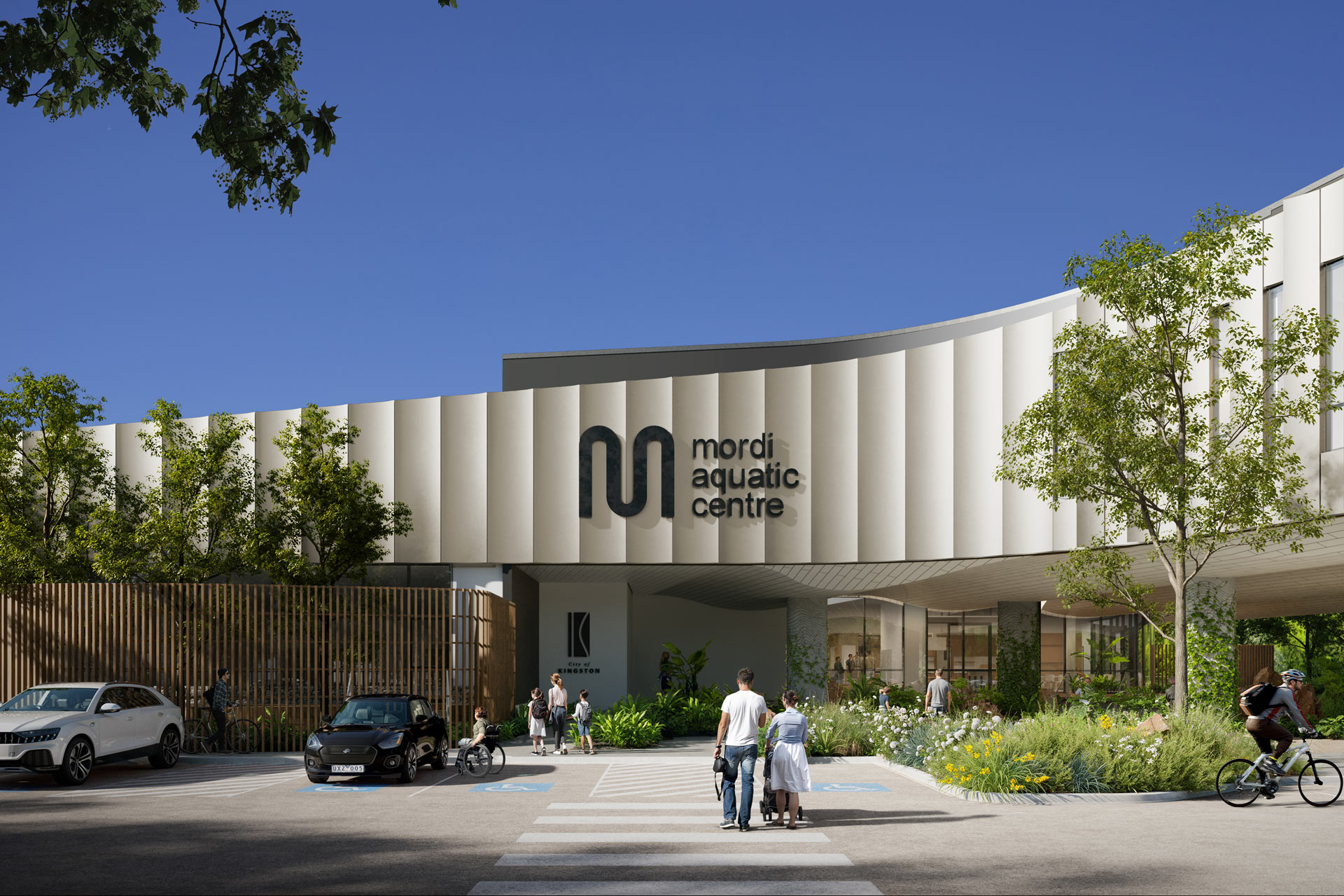
Mordi Aquatic Centre
One-Minute Animation Highlights Major Melbourne Council Project

When the City of Kingston commissioned CO.OP Studio to design what would become the largest infrastructure project ever undertaken by the council, the design team inherited a mandate defined not by a single visionary client but by an entire suburb’s worth of competing expectations.
The site at 76 Governor Road in Mordialloc, adjacent to Jack Grut Reserve in Melbourne’s south-east, had been selected from 180 potential locations.
The programme had already been defined: a 50-metre lap pool, a learn-to-swim pool, a warm-water exercise pool, a leisure pool, spa, sauna, steam room, gym, café, and changing village.
The $87.5 million all-electric facility, jointly funded by the City of Kingston and the Australian Government, was already a civic commitment before it was a building. What it still needed was a way to be seen.
ZOA Studio was brought in to produce a hero render of the entrance and a one-minute animation.
The first creative concept we developed was closer to architecture cinema than community communication. Slow, deliberate camera moves. Empty corridors, still water, light tracking across surfaces. The facility presented as pure spatial experience, what the team internally referred to as architecture porn. The building without its inhabitants, stripped down to geometry, material, and atmosphere. It was a legitimate idea and, in other contexts, exactly the right one.
After the first concept was rejected, our team moved in the opposite direction. The second concept shifted from architectural contemplation to human energy: a film told through the people who would actually use the place. Lifeguards, swimmers, parents watching children at play, gym-goers mid-session, a staff member behind the reception desk. The camera moved the way people move through a facility they already know and love.
The signature technique became a dual-tempo edit: one central figure in real-time while the surrounding environment accelerates into time-lapse around them. It is a cinematic device borrowed from feature film, not from architectural presentation norms, and it worked precisely because it does not appear in the standard visualization playbook.
Even the on-screen text overlays, a detail that can easily become visual noise, were integrated into the 3D environment rather than applied as flat graphic labels. These are small decisions, but they often determine whether a film is remembered or ignored.
Water simulation formed a significant technical component of the production. Splashing children, the soft cascade of a mushroom fountain, and the surface of an active lap lane each required dedicated fluid dynamics work. The materials throughout — tile specifications, metal cladding details, and surface finishes — were supplied directly by CO.OP Studio, and reproduced with photorealistic accuracy inside the 3D environment.
The Parks and Leisure Australia VIC/TAS Regional Awards of Excellence recognized the Mordi Aquatic Centre with its Strategic and Master Planning Award, an acknowledgment of the process CO.OP Studio navigated, from six rounds of public consultation to a design that genuinely reflects what the Kingston community asked for. That is not a small achievement in a typology where budgets are fixed, programmes are prescribed, and the client is effectively everyone.
Our role was to translate that achievement into something a non-architect could feel in sixty seconds.
The lesson Mordi offers is not specific to aquatic centres or municipal commissions. It applies to every project.
The instinct, in visualization, in architecture, in any creative discipline operating under constraint, is to scale the ambition down to match the perceived ceiling. But a one-minute animation for a community pool in Melbourne’s south-east can carry a real concept, a distinct cinematic voice, and a technique the client liked enough to request again on the next project. The budget does not determine the quality of the thinking. It determines the scope of the execution.
Project details
Location
Melbourne, Australia
Architect
Client
Team
Róbert Andrékó
Mohamed Atef
Marcos Martinez
Matteo Piccini
