Banff National Park
Renderings for a Reimagined Visitor Centre and Community Space in Canada
A competition in the heart of a World Heritage Site

On May 13, 2026, Parks Canada announced the winning design for a reimagined visitor centre and community space in Banff National Park, the centrepiece of the 200-Block Banff Avenue Redevelopment Project run in partnership with the Royal Architectural Institute of Canada (RAIC).
The site sits in the middle of the town of Banff, a townsite inside the Canadian Rocky Mountain Parks UNESCO World Heritage Site. Around 80 percent of the park’s visitors pass through this block. Whatever lands here has to hold a heritage building from 1939, a net-zero-carbon ambition, and a record 4.5 million visitors annually, all without raising its voice over Mount Rundle.
An independent RAIC jury weighed a shortlist of pre-qualified teams that included Revery Architecture, Kengo Kuma & Associates, Paul Raff Studio, EVOQ + Ryder, KPMB Architects, and Stantec Architecture, each judged on landscape, sustainability, heritage, and visitor experience.
As the architectural visualization studio behind Revery Architecture’s entry, our job was to take a building and let a jury feel what it would be like to stand inside it. This is the part of the story that interests us most as image-makers, and architects too.
The place of mountains
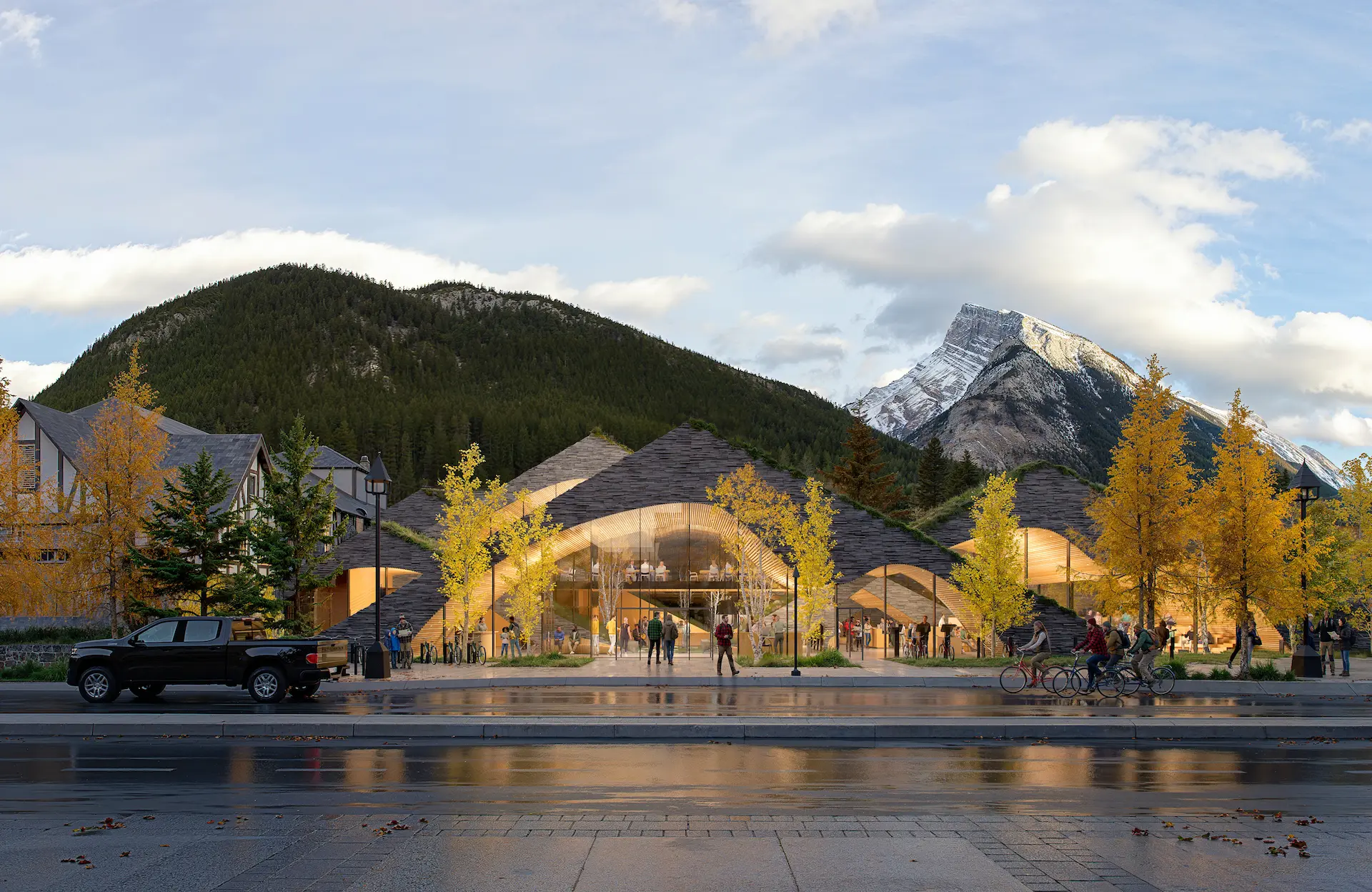
Revery, the Vancouver studio, called its proposal ‘The Place of Mountains.’ The narrative is clear: a building where locals and visitors gather to learn and celebrate the place, and where the connection to the land becomes architecture. Revery framed it as a Living Land Legacy, drawing form from ‘anchoring mountains, cultural footprints, vibrant ecosystems, rivers, wildlife, and the people of the Bow Valley,’ all moving in continual rhythm.
You can read that intent directly off the renderings. The exterior reads as a small mountain range pulled down to street height, its ridgelines rhyming with the forested slope and Mount Rundle’s snow behind it. Where most civic buildings would assert a façade, this one dissolves into glass at the base, so the warm cedar interior glows out under the stone like light under a tent. The plan, once you trace it, is a set of mountain-like roofs sheltering the hubs beneath — meeting rooms, exhibition spaces, and offices — with glass doing the quiet, decisive work of erasing the line between inside and outside.
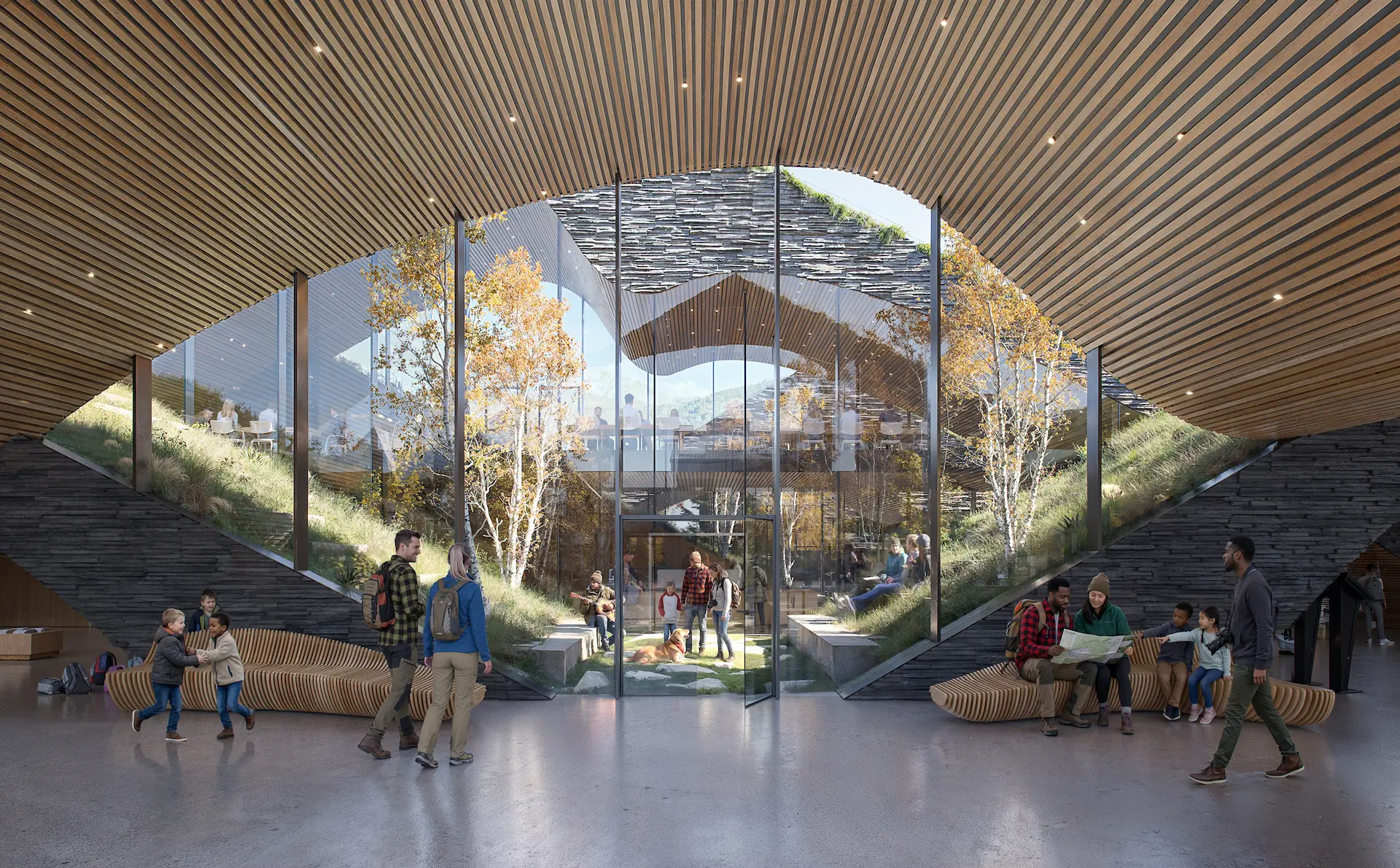
Step into the great hall and the slate “mountains” continue indoors, planted with grass and birch, a glazed courtyard at the centre where a family and a golden retriever stand on real ground that appears to run straight through the building.
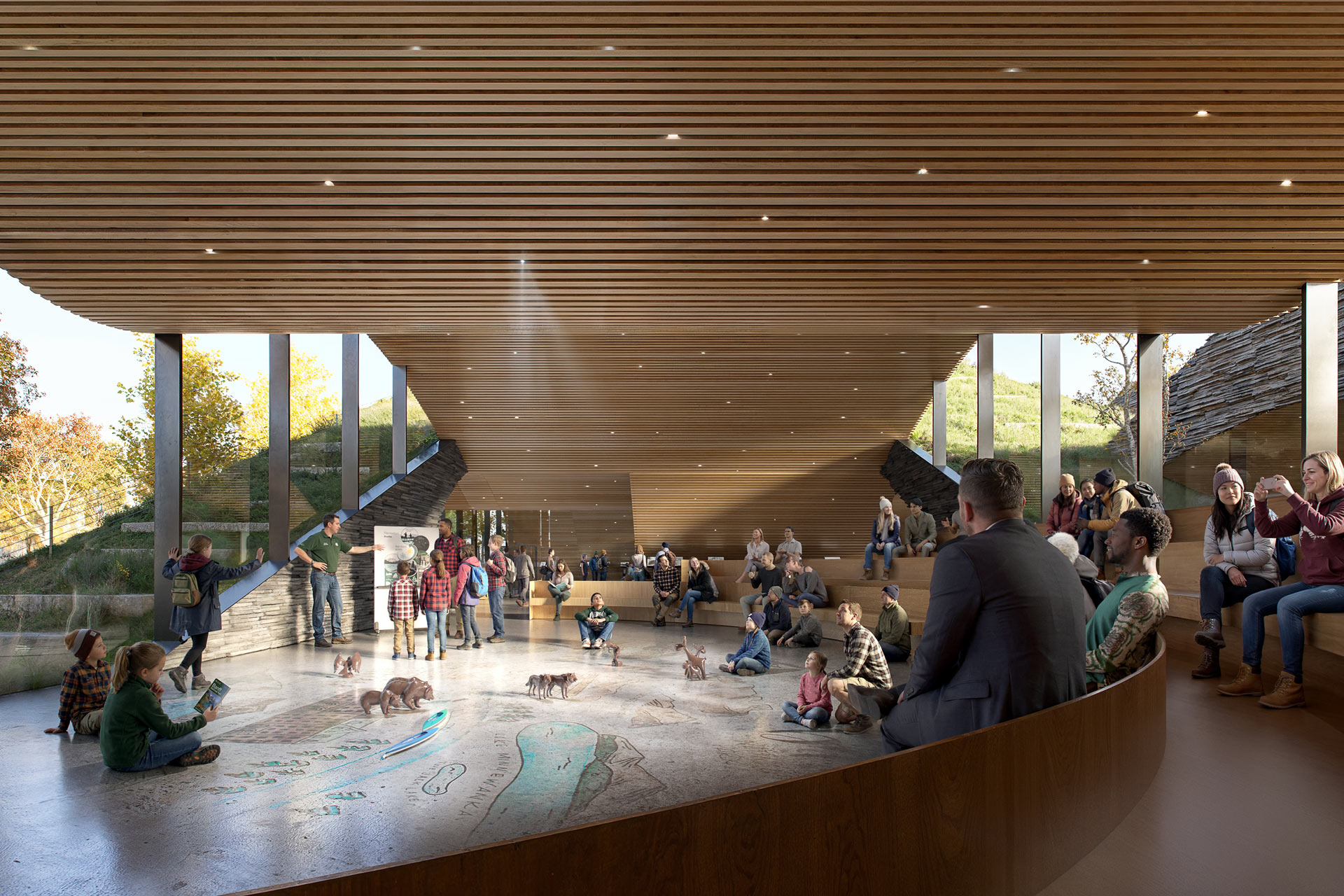
The most generous move is the one aimed at children. The floor of the gathering hall carries an inlaid map of the national park, the braided Bow River, the place names, the territory, with bronze wildlife set on it like pieces on a board, so a ranger can crouch and teach a six-year-old where the bears and wolves actually live. It is an interpretation. Our lead artist on the project, Mariia, put it plainly: the centre was never meant to be a place tourists pass through, but the point where the journey starts.
Making the local feel local
We delivered four photoreal renderings, three interiors and one exterior, distilled from eighteen initial sketches. The wide latitude in the schedule and an unusually well-built architectural model let us explore the plan properly.
The brief to us was interiors, and the hardest challenge in those interiors was not the design. It was the people. Parks Canada wanted Banff to read as the multicultural destination it is, which meant populating the halls with visible breadth, nationalities, ages, the specific wardrobe of a Canadian park, the plaid and the ranger green that signal this place the instant you see them. Sourcing that range of figures, dressed for exactly this setting, is a notorious bottleneck in photorealistic architectural renderings. This was the first project where we leaned hard on AI image generation techniques to handle the diversity and the costumes. Getting them right was a real challenge.
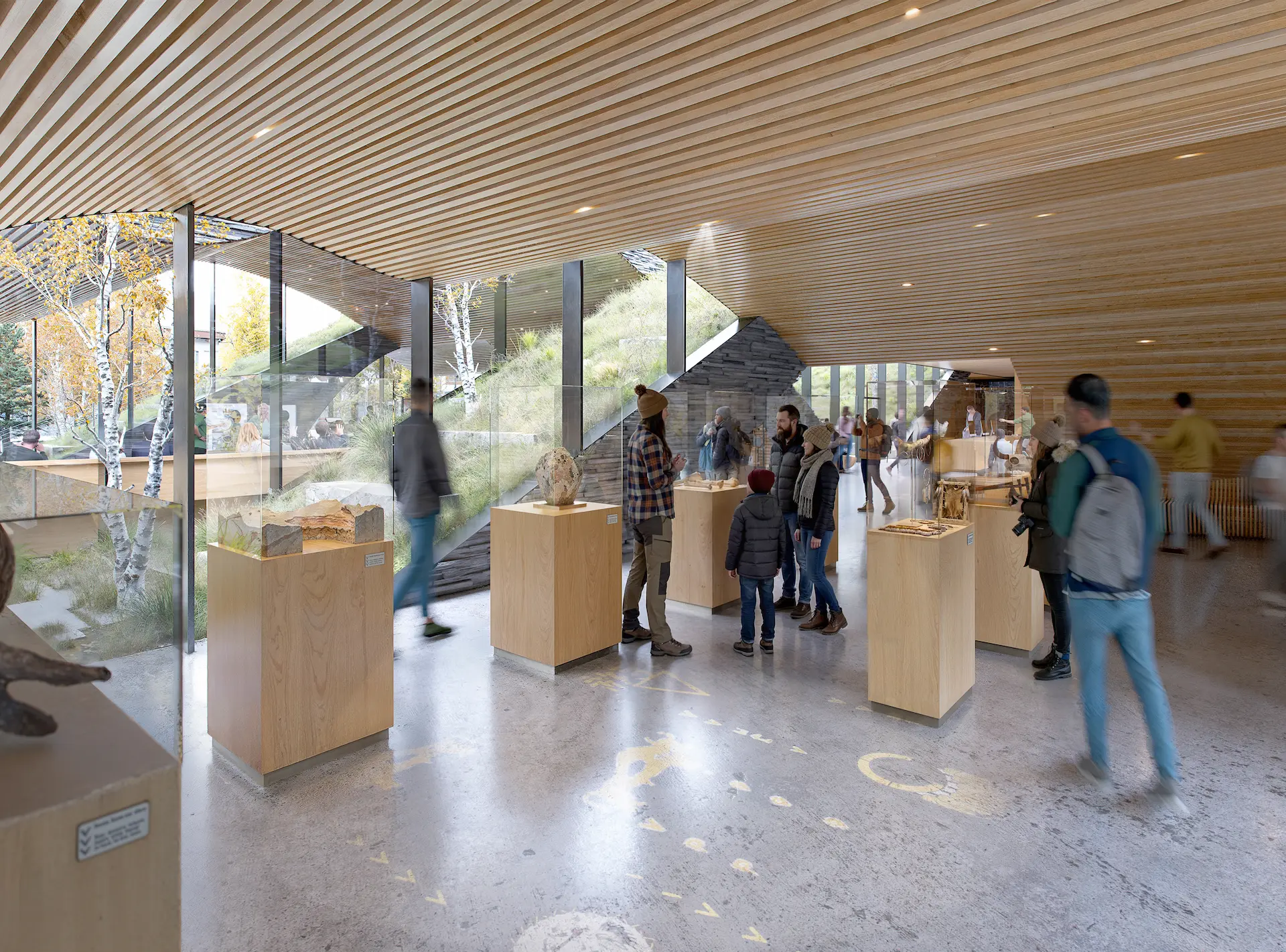
The exhibition spaces ran on a different kind of collaboration, roughly fifty-fifty between our team and Revery. We invented the display language: wooden plinths on slim metal bases, the natural objects you would expect a park to show, stones, mineral specimens, weathered branches. Then Revery brought in a specialist who knew the actual collection: animal bones, ancient artifacts, references to the historic buffalo crossings, all verified as genuinely of this specific stretch of the Bow Valley.
Caring about the architecture
We were briefed for interiors only. But we fell for the architecture, the way those triangulated roofs flex and repeat the mountains behind them, and we sketched the exterior anyway. The team loved how the render caught the building, and approved it as an extra. That image became the main presentation image for the proposal on the competition site. The one picture nobody commissioned ended up as the face of the scheme. We will take that as evidence for something we believe: images serve the project, and the best ones come from caring about the architecture as if it were your own.
Project details
Location
Banff, Canada
Partner
Client
Team
Mariia Lazaryk
Marcos Martinez
